
Understanding the journey of paediatric hearing care and restoration in Singapore
The discovery of a hearing challenge in a child is a significant moment that requires a structured and supportive response from both medical professionals and the family unit. In Singapore, the approach to paediatric auditory health is world-class, combining early detection programmes with advanced rehabilitative technology. Because hearing is the primary gateway for language acquisition and social development, the speed and accuracy of intervention are paramount. From the initial newborn screening at the hospital to the long-term management of complex auditory conditions, families have access to a comprehensive network of specialists. This article outlines the essential stages of the hearing care journey, the differences between various types of hearing impairment, and the advanced surgical options available for those with profound loss.
Key Takeaways:
- Early identification through universal newborn screening is the first step toward successful language development.
- Diagnostic assessments differentiate between temporary conductive issues and permanent sensorineural hearing loss.
- Digital hearing aids serve as the primary non-surgical intervention for the majority of paediatric cases.
- Surgical solutions are explored when traditional amplification does not provide sufficient clarity for speech understanding.
- Holistic rehabilitation involving speech therapy and family support is vital for long-term communicative success.
The critical role of early detection and newborn screening
The healthcare system in Singapore places a heavy emphasis on early detection through the Universal Newborn Hearing Screening programme. This initiative ensures that almost every infant born in a local hospital undergoes a non-invasive hearing test within the first few days of life. The goal of this programme is to identify potential hearing issues by three months of age, allowing for a structured intervention plan to be in place by the six-month mark. This timeline is not arbitrary; it aligns with the critical period of brain plasticity when the neural pathways for language are most receptive to stimulation.
The screening typically involves two types of technology: Otoacoustic Emissions and Automated Auditory Brainstem Response. These tests measure the physical response of the inner ear and the electrical activity of the hearing nerve. If a child does not pass the initial screening, it does not immediately signify permanent deafness, but it does necessitate further diagnostic evaluation. By catching potential issues early, the medical community ensures that children do not miss out on the vital auditory input required for their cognitive and social milestones.
Differentiating between conductive and sensorineural hearing loss
To manage a child's hearing effectively, it is necessary to understand the nature of the impairment. Hearing loss is generally categorised into two main types: conductive and sensorineural. Conductive hearing loss occurs when sound is blocked from reaching the inner ear, often due to fluid buildup behind the eardrum, a common occurrence after a cold or ear infection. In many instances, this type of loss is temporary and can be resolved through medication or minor surgical procedures like the insertion of ventilation tubes.
Sensorineural hearing loss, on the other hand, involves damage to the delicate hair cells within the cochlea or the auditory nerve itself. This type of loss is typically permanent and requires technological intervention to facilitate communication. In some cases, a child may present with a mixed hearing loss, which is a combination of both types. Identifying the specific cause allows the clinical team to tailor a management plan that addresses the physical health of the ear while prioritising the child’s access to the world of sound.
The transition from diagnosis to technological intervention
Once a permanent hearing loss is confirmed, the focus shifts toward providing the child with the best possible access to speech sounds. For the majority of children, this begins with the fitting of high-quality digital hearing aids. Modern hearing technology is incredibly sophisticated, allowing audiologists to program the devices to amplify only the specific frequencies where the child has a deficit. This ensures that speech is audible and clear without being uncomfortably loud.
The process of fitting hearing aids in children is a collaborative effort. Audiologists use real-ear measurements to ensure the sound levels are safe for a small ear canal, while parents provide feedback on the child’s behavioural responses to sound at home. Because children’s ears grow rapidly, frequent appointments are necessary to update ear moulds and adjust the digital settings. The ultimate aim is to provide a consistent auditory signal that allows the child’s brain to begin the complex process of learning to interpret and produce language.
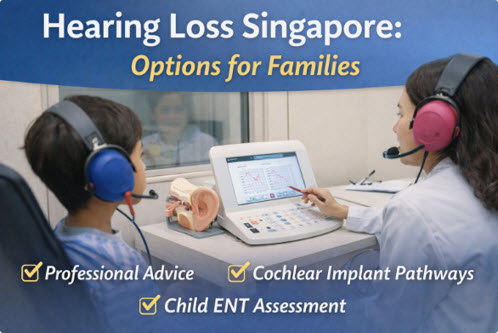
Exploring advanced surgical solutions and cochlear implant Singapore
In situations where a child has a profound sensorineural hearing loss, even the most powerful hearing aids may not provide enough clarity for the brain to understand speech. When traditional amplification is insufficient, the medical team may begin a comprehensive evaluation for a cochlear implant Singapore. Unlike a hearing aid, which makes sounds louder, a cochlear implant is a surgical device that bypasses the damaged parts of the inner ear and directly stimulates the auditory nerve using electrical signals.
The evaluation for such a device is an intensive process involving ENT surgeons, audiologists, and speech therapists. The team assesses the child's inner ear anatomy through imaging and evaluates their current progress with hearing aids. In Singapore, clinical standards encourage early implantation for suitable candidates, often around one year of age, to maximise the benefits of the brain’s developmental window. While the surgery is a significant step, it is the beginning of a new chapter in the child's ability to connect with their family and peers through spoken language.
The necessity of long-term rehabilitation and therapy
Providing a child with hearing technology is only one part of the equation; the second part is teaching the brain how to use that technology. This is where auditory-verbal therapy and speech-language pathology play a vital role. After a device like a cochlear implant is activated, the child begins to hear sounds, but those sounds do not initially have meaning. Therapy sessions focus on training the child to listen, discriminate between different sounds, and eventually produce speech.
In Singapore, therapy is family-centred, meaning that parents are active participants in every session. Therapists provide caregivers with the tools and strategies needed to turn everyday activities—like mealtime or play—into listening opportunities. This consistent stimulation is what allows a child with profound hearing loss to eventually achieve language skills that are comparable to their hearing peers. The journey requires patience and persistence, but the long-term rewards of clear communication and social integration are invaluable.
Educational support and mainstreaming opportunities
As children with hearing impairment reach school age, the focus of their support network expands to include the educational system. The Ministry of Education in Singapore provides various resources to ensure that these students can thrive in mainstream environments. This may include the use of FM systems or remote microphones, which stream the teacher’s voice directly into the child’s hearing device, overcoming the challenges of distance and background noise in a busy classroom.
For some families, specialised educational settings may be a more appropriate choice, depending on the child's individual needs and communication mode. However, the advancements in early intervention and technology mean that a growing number of children with significant hearing loss are successfully integrating into mainstream schools. By maintaining a strong partnership between the clinical team, the school, and the family, parents can ensure that their child has the necessary accommodations to reach their academic potential and build meaningful friendships.
Prospects and the commitment to auditory wellness
The landscape of paediatric hearing health is constantly evolving, with ongoing research into better sound processing, gene therapy, and more refined surgical techniques. In Singapore, families are at the forefront of these advancements, benefiting from a healthcare system that prioritises evidence-based care and patient outcomes. While the initial diagnosis of hearing loss can be overwhelming, the path forward is paved with professional expertise and life-changing technology.
Maintaining auditory wellness is a lifelong commitment that continues through adolescence and into adulthood. Regular audiological reviews ensure that technology is updated as the individual's needs change and that any further changes in hearing are managed promptly. By leveraging the comprehensive support systems available in Singapore, families can navigate the complexities of hearing loss with clarity and hope, ensuring that their children grow up empowered to communicate, learn, and succeed in a hearing-centric world.
Read another Article: Integrated healthcare strategies for ear infection prevention and auditory wellness