
Enhancing Security Resilience with Power Redundancy
Maintaining a secure commercial facility in Singapore requires more than just high-quality locks and digital readers. As businesses increasingly rely on electronic security infrastructure, the dependence on a stable electrical supply has become a critical vulnerability. A security system is only as effective as its uptime; if the power fails, the entire perimeter may be compromised. This article explores the necessity of integrating professional power redundancy into your building management strategy. By understanding the role of uninterruptible power supplies, organisations can protect their sensitive hardware from electrical fluctuations and ensure that their security measures remain fully operational during unforeseen outages, providing constant peace of mind for facility managers.
Key Takeaways:
- Electronic security hardware requires constant power to maintain a secure building perimeter.
- Professional power backups prevent system crashes and data loss during sudden electrical surges.
- Integrated redundancy ensures that electronic locks function correctly for life safety during outages.
- High-quality power solutions protect delicate circuitry in biometric and RFID readers from damage.
- Expert installation provides a seamless transition between mains and battery power without system lag.
The Vulnerability of Electronic Entry Systems [H2]
In the modern business environment, traditional mechanical keys have largely been replaced by digital credentials. These systems offer control and tracking but introduce a total reliance on electricity. Every component of the system, from the central management server to the individual door controllers and electromagnetic locks, requires a consistent flow of power to operate. When the primary electrical grid fails, an unprotected system will either lock down or default to an open state, both of which present significant risks to a business.
For Singaporean companies handling sensitive data or valuable inventory, even a few minutes of downtime is problematic. This is why the planning phase of any security installation must account for electrical resilience. Relying solely on the building’s main power is a risk that can lead to security breaches, trapped personnel, or the corruption of entry logs. A professional approach involves calculating the total power load of all security devices to ensure that the backup infrastructure is capable of supporting the entire network for an extended period.
Ensuring Continuity with Uninterruptible Power Supplies [H2]
The most effective way to counter electrical instability is through the deployment of uninterruptible power supplies. These units serve as a critical bridge between the mains power and your security hardware. In the event of a blackout or a brownout, uninterruptible power supplies provide immediate battery power to the connected devices. This transition is designed to be seamless, ensuring that the system does not experience a hard reboot, which can often lead to software errors or the loss of recent data logs.
Beyond providing backup power during a total outage, uninterruptible power supplies also act as a buffer against poor power quality. Electrical grids often experience noise, spikes, and sags that can degrade delicate electronic components over time. By conditioning the power before it reaches your readers and controllers, these units extend the lifespan of your security investment. For high-security environments, such as data centres or research labs, having dedicated uninterruptible power supplies for the security network is a standard requirement to guarantee that the site remains secure at all times.
Life Safety and Emergency Exit Compliance [H2]
A significant concern during a power failure is how the building’s exit doors will behave. In Singapore, fire safety regulations are strict regarding electronic locking mechanisms. In an emergency, occupants must be able to evacuate the building safely, regardless of whether the power is active. Professional security installers ensure that the system is configured correctly, but the presence of uninterruptible power supplies adds a vital layer of control.
With a professional backup solution, the system can maintain the fail-safe or fail-secure status of each door according to its specific programming. For example, main exit doors can be programmed to unlock automatically during a confirmed fire alarm, while high-security internal rooms can remain locked and powered by uninterruptible power supplies to protect assets. This level of granular control is only possible when the system has a dependable and redundant power source that allows it to continue executing its safety protocols even when the main building lights go out.
Technical Requirements for Power Redundancy [H2]
Selecting the correct backup solution is a technical task that requires professional expertise. Not all uninterruptible power supplies are suitable for security applications. Installers must consider the run time required—how long the batteries will last under full load—and the recharge time to ensure the system is ready for subsequent outages. Furthermore, the units must be integrated into the wider building management software so that facility managers receive immediate alerts when the system switches to battery power.
The placement of these units is also a critical factor. They are typically housed in secure, ventilated server racks alongside the network controllers to prevent overheating and tampering. Regular maintenance and battery testing are essential to ensure that the uninterruptible power supplies will perform when needed. A professional service provider includes these checks in their maintenance plans, ensuring that the batteries are replaced before they reach the end of their useful life. This proactive approach prevents the backup system itself from becoming a point of failure.
Protecting the Integrity of Security Data [H2]
Modern security is as much about data as it is about physical barriers. Every entry and exit event is recorded in a database, creating an audit trail that is essential for compliance and internal investigations. If a system loses power suddenly, there is a risk that the data currently being written to the database will be corrupted. This can lead to gaps in the security record, making it difficult to verify who was in the building during a specific window of time.
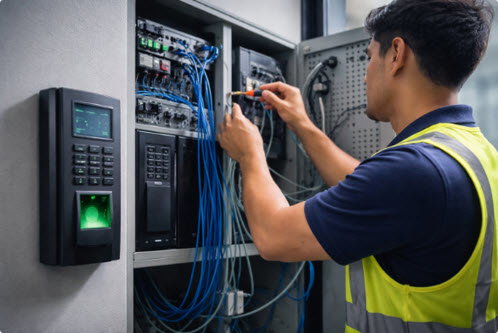
By utilising uninterruptible power supplies, businesses protect the integrity of their digital records. The backup power provides enough time for the system to either continue operating through a short outage or to perform a graceful shutdown if the outage is prolonged. This ensures that all logs are saved and that the database remains healthy. For organisations that must adhere to strict data protection standards, this level of infrastructure resilience is a necessary component of their overall risk management strategy.
Long-Term Value of Professional Power Solutions [H2]
While the integration of uninterruptible power supplies represents an additional upfront cost, the long-term value they provide is substantial. The cost of a single security breach or the replacement of a damaged control panel often far exceeds the price of a professional backup unit. Furthermore, the peace of mind that comes from knowing your facility is protected against electrical fluctuations is helpful for business owners and facility managers.
Investing in high-quality power redundancy is a hallmark of a professional security posture. It demonstrates a commitment to both the safety of personnel and the protection of assets. By working with experienced installers who understand the unique electrical and regulatory landscape in Singapore, businesses can build a security infrastructure that is not only smart and convenient but also resilient and dependable. In an increasingly digital world, the stability of your power is the foundation of your security.
Integrating Redundancy into the Security Design [H2]
A comprehensive security design looks at the facility as a whole. It is not enough to have a backup for the main server if the individual door controllers are left without power. Professional installers design a distributed power architecture where uninterruptible power supplies are placed strategically throughout the building. This ensures that even if a local circuit breaker trips, the local security devices remain active.
This integrated approach also simplifies the management of the system. Modern uninterruptible power supplies can be monitored over the network, allowing IT staff to see the health of every battery from a central dashboard. They can receive notifications about power quality issues before they lead to hardware failure. By making power redundancy a core part of the initial security design, businesses avoid the complications and extra costs of trying to retrofit these systems later, ensuring a more cohesive and robust protection strategy from day one.
Read another Article: Expert Strategies for Reliable Building Entry Systems
